Using Eye Blink Behavior to Sense Attention
How we translated cognitive neuroscience into a non-invasive HCI telemetry.
Why Look at Eye Blinks
When people are visually focused, they blink less.
This is not a habit or a choice. It is a physiological response.
Spontaneous eye blinks briefly block visual input. During tasks that demand sustained attention, the visual system suppresses blinking to avoid losing information. As attention loosens or cognitive resources are depleted, blink rate and blink duration increase again.
This makes eye blink behavior a useful, passive signal for inferring attention state.
Evidence From Prior Research
Blink Rate Drops During Sustained Attention
Across reading, monitoring, and problem-solving tasks, studies consistently report large reductions in blink rate during focused visual attention.
Blink rate drops sharply during sustained visual attention compared to rest.
Key sources
Orchard & Stern (1991), Bentivoglio et al. (1997)
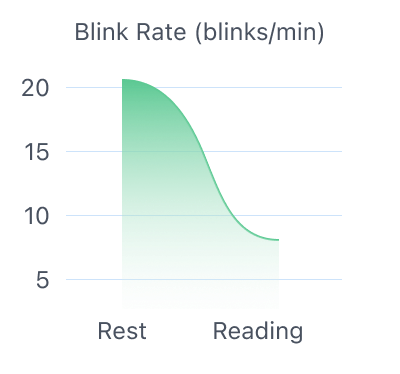
Sketch 1: Blink Rate by Task Condition
Blink Suppression Scales With Task Difficulty
As task difficulty increases, blink rate decreases and inter-blink intervals lengthen. This relationship has been observed in controlled workload experiments.
Key sources:
Veltman & Gaillard (1998), Recarte et al. (2008)
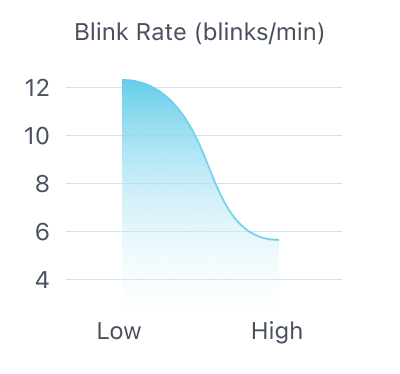
Sketch 2: Blink Rate by Task Difficulty
Why Blink Behavior Is Not Conscious Control
Participants do not intentionally modulate blink behavior.
Blink suppression and rebound occur automatically, without subjective awareness.
Neuroscience research links spontaneous blink rate to underlying dopaminergic and attentional systems, not deliberate effort.
This makes blink behavior particularly valuable for HCI systems that aim to sense internal state without relying on self-report or explicit user input.
Key sources:
Karson (1983), Jongkees & Colzato (2016)
Conclusion
Prior research shows that eye blink behavior systematically changes with attention, cognitive load, and fatigue. Blink suppression reflects focused visual attention, while increased blink rate and duration indicate overload and declining control. These effects are automatic, unconscious, and measurable in real time, making eye blinks a viable signal for attention-aware, human-centered systems.